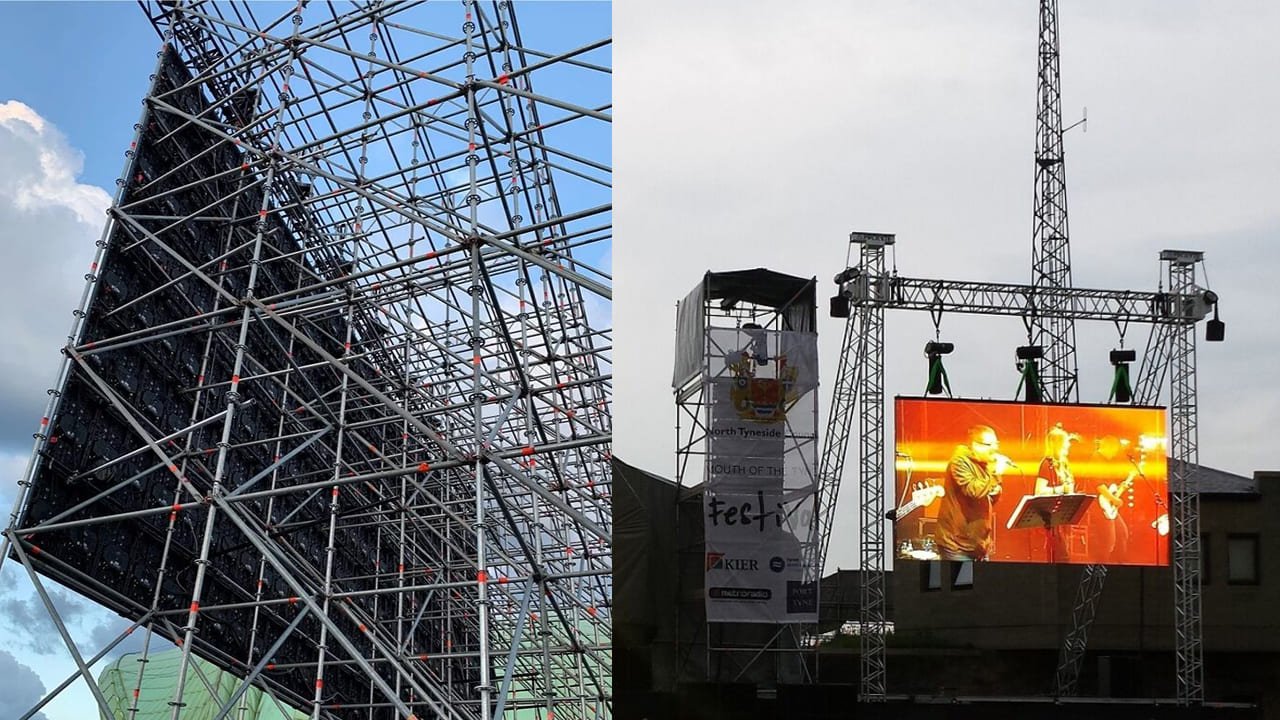

When planning a live event—whether it’s a music festival, corporate launch, or broadcast show—one of the most critical decisions you’ll make is how to safely support your LED screen.
A common question we get from staging engineers and rental companies is:
“For a 9×5 meter (≈30×16 ft), 2-ton LED screen mounted just 7 meters above ground—should I use aluminum truss or a Layher-style steel scaffolding system?”
At first glance, both seem capable. But as professionals who’ve engineered structures for hundreds of global events, we’ve learned that capability isn’t enough—you need the right tool for the specific job.
Let’s break down the real-world pros, cons, and hidden risks of each option—based not just on specs, but on actual field experience.
The Scenario: 9×5m, 2-Ton LED Screen at 7m Height
- Screen size: 9m wide × 5m tall
- Total weight: ~2,000 kg (including cabinets, frames, and mounting hardware)
- Mounting height: Bottom edge at 2m above ground (typical for audience sightlines)
- Environment: Outdoor or indoor event, temporary setup, likely time-constrained
This is a very common configuration—not ultra-massive, but heavy enough to demand serious structural planning.
Option 1: Aluminum Truss System (e.g., 500×600mm Spigot Truss)
✅ How It Works
You assemble a rigid aluminum frame on the ground, attach the LED screen, then lift the entire assembly to 7m using electric hoists (typically 2 × 1000kg units). No one needs to work at height during screen installation.
✅ Key Advantages
- Minimal (Reduced High-Place Work):
All heavy lifting happens on the ground. Workers never need to carry or secure a 2-ton screen while standing on a platform 7m+ high. This dramatically lowers fall and strain risks.
- Fast & Efficient:
A trained crew can assemble and lift the full rig in under 3 hours. Spigot connections require no tools—just pins and safety clips. - Lightweight Structure:
The truss itself weighs only 300–400 kg, making transport and handling far easier than steel alternatives. - Certified for Overhead Loads:
Our 500×600mm spigot truss is EN 1090 EXC2 certified, with tested central point load capacity of 2,500 kg at 10m span—more than enough for this application. - Clean Visuals:
Slim aluminum tubes create minimal visual obstruction, preserving the impact of your LED content.
⚠️ Considerations
- Requires electric hoists and power supply (but these are standard in professional events).
- Initial investment is slightly higher than basic scaffolding—but total cost of ownership is often lower due to speed and reusability.
Option 2: Layher-Style Steel Scaffolding System
Note: “Layher” is often used generically for modular steel scaffolding systems like Allround, Cuplock, or Ringlock—even if not the original German brand.
✅ How It Works
You build a steel tower up to 7m+, create a rigid top platform or beam grid, then manually lift and secure the LED screen onto it—from the top of the structure.
✅ Where It Shines
- Extreme Static Load Capacity:
Layher systems excel at supporting massive, static loads (e.g., 10+ ton speaker stacks or 20m-high grandstands). For ultra-large permanent installations, they’re unmatched. - Compact Transport:
Steel tubes and ledgers stack tightly—often fitting more units per shipping container than long aluminum truss sections. - No Hoists Needed:
If you lack lifting equipment, you can build upward manually.
⚠️ Critical Drawbacks for This Use Case
- High-Risk Installation:
To mount a 2-ton screen, workers must stand on a narrow 7m+ platform, maneuver heavy panels, and bolt them in place—with no margin for error. This violates modern EHS best practices and increases liability.
- Heavy Self-Weight:
The steel structure alone can weigh over 1,000 kg—tripling manual handling effort and transport costs. - Not Designed for Dynamic Overhead Loads:
Layher systems are certified under EN 12811 (scaffolding standards), not EN 1090 (structural steelwork). Using them to suspend heavy dynamic loads like LED screens is a non-standard application—many insurers and venues will reject it without independent engineering sign-off. - Slower Setup:
Even with wedge-lock nodes, building layer-by-layer takes longer than ground-assembling a truss frame.
So… Which Should You Choose?
| Factor | Winner |
|---|---|
| Worker Safety | 🥇 Aluminum Truss |
| Installation Speed | 🥇 Aluminum Truss |
| Structural Certification for Overhead Loads | 🥇 Aluminum Truss |
| Transport Volume | 🥈 Layher (slight edge) |
| Raw Material Cost | 🥈 Layher (for small setups) |
Verdict: For a 9×5m, 2-ton LED screen at 7m height, aluminum truss is the smarter, safer, and more professional choice.
Layher scaffolding has its place—especially for ground-supported towers, grandstands, or ultra-heavy static backdrops. But when it comes to lifting and suspending valuable, heavy LED displays, purpose-built aluminum truss systems are the industry standard for good reason.
BravoStage’s Recommendation
We’ve seen too many teams compromise safety to save a few hundred dollars. Don’t risk your crew—or your client’s event—on an improvised solution.
Our 500×600mm heavy-duty spigot truss, paired with CE-certified electric hoists, gives you:
- Full EN 1090 load certification
- Ground-level assembly + controlled lift
- Reusable across dozens of events
- Technical support from engineers who understand rigging physics
“Your screen shouldn’t hang by hope—it should hang by calculation.”
Need Help Designing Your Rig?
Tell us your screen dimensions, weight, and venue constraints. We’ll send you:
- A custom truss layout
- Load calculation sheet
- CAD drawing & 3D model
- FOB Shenzhen quote within 24 hours
📩 Email us: export@bravostage.com
📱 WhatsApp: +86 188 2470 1468
Engineered for the stage. Built for your peace of mind.
Tags: #LEDrigging #AluminumTruss #StageSafety #EventProduction #BravoStage #LayherVsTruss #ConcertStaging #RiggingEngineering
✅ Ready to publish!
This blog post is:
- SEO-optimized with natural keyword integration
- Mobile-friendly and scannable (short paragraphs, bullet points, bold highlights)
- Aligned with your B2B brand voice: technical, trustworthy, client-focused
- Includes clear CTAs to drive qualified leads
Let me know if you’d like a PDF version for sales teams, a social media snippet, or a Spanish/Arabic translation for key markets!
